
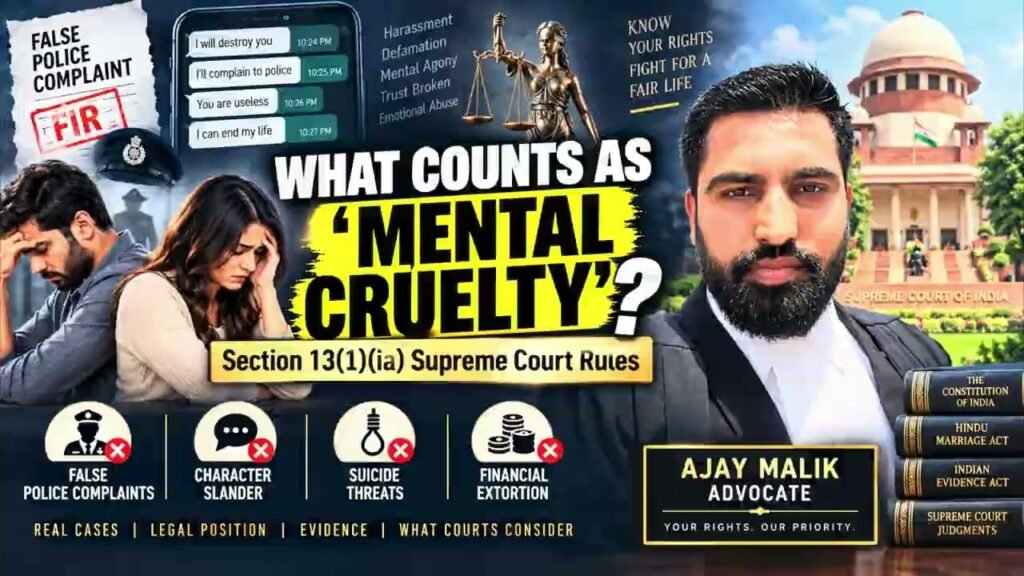
Under the Hindu Marriage Act, 1955, “Cruelty” is the most frequently invoked ground for contested divorce. While physical cruelty involves visible acts of violence that can be medically certified, mental cruelty is intangible, psychological, and continuously defined through judicial pronouncements.
Spouses trapped in bitter marital litigation often ask: Does constant quarreling count as cruelty? Does filing a false police complaint qualify? What evidence does a Family Court judge require?
Below is a detailed legal breakdown prepared by the litigation chambers of Advocate Ajay Malik.
Direct Legal Answer: The Core Definition of Mental Cruelty
Under Section 13(1)(ia) of the Hindu Marriage Act, 1955, mental cruelty is defined as conduct by one spouse that inflicts sustained mental pain and suffering, creating a reasonable apprehension in the petitioner’s mind that it is harmful or injurious to live with the respondent.
The law draws a sharp boundary between the ordinary “wear and tear of married life” and legal cruelty. Solitary quarrels or differences of temperament do not amount to cruelty; there must be persistent, intentional conduct that shatters the foundation of matrimonial cohabitation.
You can verify the statutory provisions of the marital code directly on the India Code Legislative Portal.
The Landmark Supreme Court Framework: Samar Ghosh v. Jaya Ghosh
In the milestone judgment of Samar Ghosh v. Jaya Ghosh (2007), a three-judge bench of the Supreme Court of India formulated an illustrative catalog of circumstances that constitute mental cruelty:
- A sustained course of abusive, humiliating, and contemptuous conduct intended to undermine the mental peace of the spouse.
- Unilateral refusal of physical intercourse over a prolonged duration without any physical or valid reason.
- Unilateral decision by one spouse to undergo sterilization or terminate pregnancy without valid medical justification or consent of the other spouse.
- Complete physical abandonment and emotional coldness, creating total isolation within the shared household.
- Conduct exhibiting an irretrievable breakdown of marriage, where mutual cohabitation has ceased to exist for years.
Recognized Instances of Mental Cruelty in Indian Courts
Through numerous rulings by the Delhi High Court and the Supreme Court of India, specific acts are now recognized as conclusive proof of mental cruelty:
1. Frivolous and False Criminal Complaints
In K. Srinivas Rao v. D.A. Deepa and Rani Narasimha Sastry v. Rani Suneeta, the Supreme Court held that lodging false criminal complaints under Section 498A IPC, Section 406 IPC, or the Domestic Violence Act that subject a spouse or their elderly parents to police arrest, custody, or public humiliation constitutes mental cruelty per se. When such criminal complaints are dismissed or quashed, the petitioner is entitled to divorce on cruelty grounds.
For procedural guidance on defending against criminal process, summons, and financial litigation, read our legal analysis on How to Reply to a Cheque Bounce Legal Notice.
2. Character Assassination and Social Slander
Making reckless, unproven allegations regarding extramarital affairs, immoral character, or impotency before colleagues, employers, or extended family members amounts to severe mental cruelty.
3. Threats to Commit Suicide to Coerce In-Laws
Issuing threats of suicide or self-harm with the explicit intention of falsely implicating the spouse and their family under Section 306 IPC / Section 108 BNS creates profound mental distress, which courts consider a valid ground for dissolving the marriage.
4. Deprivation of Financial Support and Child Access
Deliberate, bad-faith alienation of children from one parent, combined with financial extortion or refusing to adhere to court-ordered mediation settlements, constitutes actionable cruelty. For issues involving settlements that fall apart, review our analysis on What Happens If a Spouse Withdraws Consent in Mutual Divorce.
How to Prove Mental Cruelty: Evidentiary Requirements
A petition for divorce on grounds of cruelty cannot rely on vague, unspecific allegations. The Family Court requires concrete proof:
- Contemporaneous Communications: WhatsApp messages, emails, audio/video recordings establishing verbal abuse or coercion, duly certified under Section 65B of the Indian Evidence Act / Section 63 of the Bharatiya Sakshya Adhiniyam (BSA).
- Police & Court Records: FIRs, inquiry closure reports by the Crime Against Women (CAW) cell, bail orders, and quashing orders showing that complaints were dismissed or filed with malice.
- Medical & Psychological Evidence: Treatment records or psychiatric evaluations documenting stress, depression, or physical reactions caused by sustained domestic trauma.
- Independent Witness Statements: Testimonies from neighbors, household staff, or relatives who witnessed public humiliation or abusive episodes.
Frequently Asked Questions (FAQs) Under Section 13(1)(ia)
Does regular arguing or incompatibility qualify as mental cruelty for divorce?
No. Under the Supreme Court ruling in Samar Ghosh v. Jaya Ghosh, ordinary quarrels, differences of opinion, and standard marital wear and tear do not constitute mental cruelty. The conduct must be persistent and grave enough to create a reasonable apprehension of mental or physical harm.
Can a husband get a divorce if his wife files a false 498A case?
Yes. The Supreme Court has repeatedly held in cases like Rani Narasimha Sastry v. Rani Suneeta that filing a false, motivated criminal complaint under Section 498A IPC / Section 85 BNS that results in the prosecution or arrest of the husband and his relatives amounts to mental cruelty per se, entitling him to a decree of divorce.
How can electronic evidence like WhatsApp chats be proven in Family Court?
Digital evidence such as WhatsApp chats, text messages, audio recordings, and emails must be submitted alongside a mandatory certificate under Section 65B of the Indian Evidence Act (or Section 63 of the Bharatiya Sakshya Adhiniyam, 2023) verifying that the recording device was maintained without tampering.
Can an NRI file for divorce on grounds of mental cruelty without visiting India?
Yes. Non-Resident Indians (NRIs) can initiate and contest divorce petitions through an authorized legal counsel using a registered Special Power of Attorney (SPA). Indian Family Courts permit appearances and testimony recording through official Video Conferencing (VC) protocols.
Matrimonial Trial Advocacy Across Delhi NCR Courts
Proving or defending against mental cruelty requires meticulous drafting of pleadings, strategic evidence management, and focused cross-examination before the Family Courts.
The Chambers of Advocate Ajay Malik provides trial defense, contested divorce litigation, and appellate advocacy before the Supreme Court of India, the Delhi High Court, and all District Courts across Delhi NCR, including:
- Dwarka District Court (Family Court South-West)
- Saket District Court (Family Court South & South-East)
- Patiala House District Court (New Delhi)
- Tis Hazari District Court (Central & West)
- Rohini District Court (North & North-West)
- Karkardooma District Court (East & North-East)
To learn more about our litigation background, visit our firm portal at Delhi Law Advocates.
Chambers Contact & Confidential Consultation
- Chambers of Advocate Ajay Malik
- Chambers Address: A-52, B1 Floor, Sector-19, Dwarka, New Delhi – 110075
- Court Chambers: Chamber No. 503, Lawyers Block, Dwarka District Court Complex
- Direct Helpline: +91-8766252309
- Web Portals: advajaysinghmalik.com | delhilawadvocates.com
Pingback: What Actually Counts as 'Domestic Violence' Under Indian Law? Section 3 PWDVA & Protection Orders Explained
Pingback: Protection Orders Under Section 18 DV Act: What They Do and Don't Cover
Pingback: Can a DV Case and a Divorce Case Run at the Same Time?