
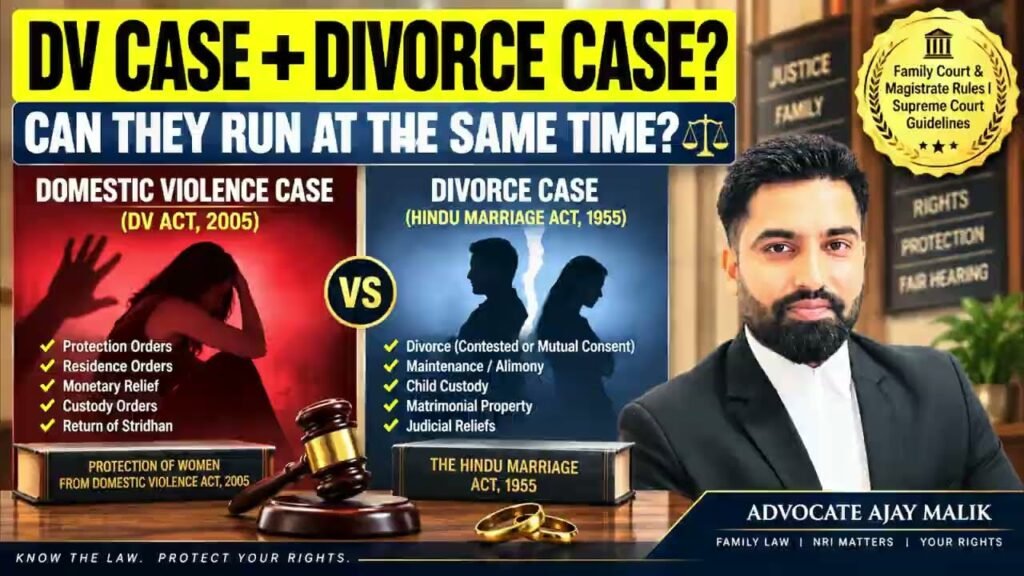
Direct Legal Answer: Yes. Under Indian law, a petition for Divorce under the Hindu Marriage Act (or Special Marriage Act) and a complaint under the Protection of Women from Domestic Violence Act, 2005 (PWDVA) are separate and distinct statutory remedies. They can, and frequently do, run simultaneously in different judicial forums. The Family Court adjudicates the dissolution of the marriage, while the Magistrate Court adjudicates immediate protective and interim reliefs. Under the Supreme Court’s Rajnesh v. Neha guidelines, any financial maintenance awarded in one proceeding will be adjusted (set-off) against the other to prevent overlapping financial burdens.
One of the most common questions clients ask when facing marital breakdown is whether the initiation of a divorce petition blocks the filing of a Domestic Violence (DV) complaint, or vice versa. The confusion often stems from the fact that both cases arise out of the same marital discord, and both may involve allegations of cruelty.
The short legal answer is that both cases can absolutely run at the same time. Below is a comprehensive legal analysis prepared by the litigation chambers of Advocate Ajay Malik, examining the distinct jurisdictions of these courts, how maintenance is handled across dual proceedings, and the strategic implications for litigants in Delhi NCR.
Watch the Legal Breakdown: Concurrent Matrimonial Cases Explained
Watch Advocate Ajay Malik explain the practical courtroom dynamics of running a DV case and a divorce case simultaneously, and how courts manage the overlapping maintenance claims:
Why Can Both Cases Run Simultaneously? (Distinct Jurisdictions)
The fundamental reason these cases can run concurrently is that they serve entirely different legal purposes and are governed by different statutes:
1. The Family Court (Divorce Proceedings)
A divorce petition (e.g., under Section 13 of the Hindu Marriage Act, 1955) is filed in the Family Court. Its primary objective is to sever the civil contract of marriage and dissolve the marital bond permanently. The Family Court also decides on permanent alimony and the permanent custody of children.
2. The Magistrate Court (Domestic Violence Act)
A DV complaint under Section 12 of the PWDVA, 2005, is filed before a Metropolitan Magistrate or Judicial Magistrate. The DV Act is a specialized welfare legislation designed to provide immediate, emergency civil relief to aggrieved women. It does not grant divorce. Instead, it grants:
- Protection Orders to stop physical or mental abuse (Section 18).
- Residence Orders to prevent eviction from the matrimonial home (Section 19).
- Monetary Relief for immediate survival (Section 20).
For more detailed information on what constitutes cruelty sufficient for divorce, read our practice guide on What Counts as Mental Cruelty in Indian Divorce Law.
The Maintenance Conflict: How Do Courts Handle Overlapping Claims?
A major point of contention when both cases run simultaneously is the issue of maintenance. Under Section 24 of the HMA, a spouse can claim interim maintenance in the Family Court. Under Section 20 of the DV Act, a wife can claim monetary relief in the Magistrate Court.
To prevent a husband from being unfairly forced to pay double maintenance for the exact same purpose, the Supreme Court of India established strict guidelines in the landmark case of Rajnesh v. Neha (2020):
- Mandatory Disclosure: Both parties must file a comprehensive Affidavit of Assets and Liabilities. In this affidavit, any pre-existing maintenance order from another court must be explicitly disclosed.
- The Rule of Set-Off (Adjustment): If the Magistrate Court awards ₹15,000 per month, and later the Family Court believes the total maintenance should be ₹20,000, the Family Court will not order an additional ₹20,000. It will “set-off” the ₹15,000 already being paid, and order the husband to pay only the differential amount (₹5,000).
For an in-depth analysis on how maintenance calculations work, review our guide on Maintenance After Divorce & Alimony Guarantees.
Frequently Asked Questions (FAQs)
Does filing for divorce mean the wife loses her right to reside in the matrimonial home?
No. Merely filing a divorce petition does not extinguish a wife’s statutory right to reside in the “shared household” under the DV Act. Until the marriage is legally dissolved by a final court decree, the Magistrate can enforce her right of residence under Section 19 of the PWDVA.
If a husband files for divorce first, can the wife still file a DV case?
Yes. The filing of a divorce petition by the husband does not act as a legal bar against the wife filing a DV complaint. She retains the right to seek protection and relief for any acts of domestic violence that occurred during the subsistence of the marriage.
Will the evidence in one case automatically be used in the other?
While the facts may be identical, the Family Court and the Magistrate Court conduct independent trials. Evidence, such as cross-examinations, must be formally proved in each respective court according to the Indian Evidence Act (now the Bharatiya Sakshya Adhiniyam, 2023). However, certified copies of orders or admissions made in one court can be strategically used to contradict the opposing party in the other court.
To examine the official legislative text of these statutory enactments, consult the India Code Central Legislation Portal.
Strategic Matrimonial Representation Across Delhi NCR Courts
Handling parallel proceedings in different courts requires a unified litigation strategy to ensure consistent pleadings and avoid contradictory statements on record.
The Chambers of Advocate Ajay Malik provides highly coordinated trial advocacy for overlapping matrimonial disputes, Section 498A criminal defense, and appellate representation before the Supreme Court of India, the Delhi High Court, and all District Courts across Delhi NCR, including:
- Dwarka District Court (Family Courts & Mahila Courts South-West)
- Saket District Court (Family Courts & Mahila Courts South & South-East)
- Patiala House District Court (New Delhi)
- Tis Hazari District Court (Central & West)
- Rohini District Court (North & North-West)
- Karkardooma District Court (East & North-East)
To learn more about our litigation background, visit our firm portal at Delhi Law Advocates.
Chambers Contact & Confidential Consultation
- Chambers of Advocate Ajay Malik
- Chambers Address: A-52, B1 Floor, Sector-19, Dwarka, New Delhi – 110075
- Court Chambers: Chamber No. 503, Lawyers Chambers Block, Dwarka District Court Complex
- Direct Helpline: +91-8766252309
- Web Portals: advajaysinghmalik.com | delhilawadvocates.com
Connect Across Our Official Media Profiles
- YouTube Channel (@ajaymalikadvocate)
- Advocate Ajay Malik Instagram (@ajaymalikadvocate)
- Delhi Law Advocates Instagram (@delhilawadvocates)
- LinkedIn Professional Profile
- Twitter / X Profile (@AdvAjayMalik)
- Facebook Official Page
- Delhi Law Advocates Facebook
- Google Business Profile (Advocate)
- Google Business Profile (Law Firm)
- Dwarka Office Location Map 1 | Dwarka Office Location Map 2
- About.me Chambers Overview
- Pinterest Legal Boards